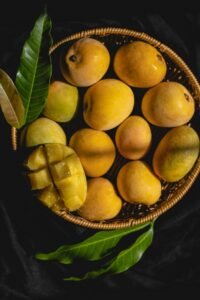
Most people experience a Ratnagiri Alphonso mango in a single, effortless moment — peeling back the skin, pressing the golden pulp to their lips, and letting the fragrance and sweetness do the rest. What they rarely see is the world that made that moment possible: the orchard at five in the morning, Darshan reading the sky for signs of unseasonal rain, the quiet knowledge that passes between a man and a tree he has tended for thirty years. At Kokan Samrat, every mango that leaves our orchards carries with it the invisible weight of a full day’s work — and this is what Darshan’s day looks like.
5:00 AM — Before the Sun, the Orchard Wakes
Darshan’s day begins in darkness, before the first light touches the Sahyadri hills to the east. The air at this hour is cool and salt-laden — the Arabian Sea is close enough that you can smell it in the orchard. This early start is not tradition for its own sake. It is strategy. The Alphonso mango is harvested in the cooler hours of the morning precisely because lower temperatures reduce the stress placed on freshly picked fruit and slow the enzymatic processes that degrade quality after separation from the tree. A mango harvested at five in the morning arrives at the grading table an hour later in far better condition than one picked in the afternoon heat.
Darshan walks the orchard first — row by row, tree by tree — before any harvesting begins. He is reading the trees. Are the fruits hanging with that particular heaviness that signals they have reached the right stage of internal ripeness? Has the skin begun to show the earliest hint of the golden-yellow shoulder that marks an Alphonso on the verge? Are there any fruits on the ground from overnight — a sign of over-ripeness on a particular tree that Darshan needs to address before the day’s picking begins ?
7:00 AM — The Harvest: Hand, Pole, and Patience
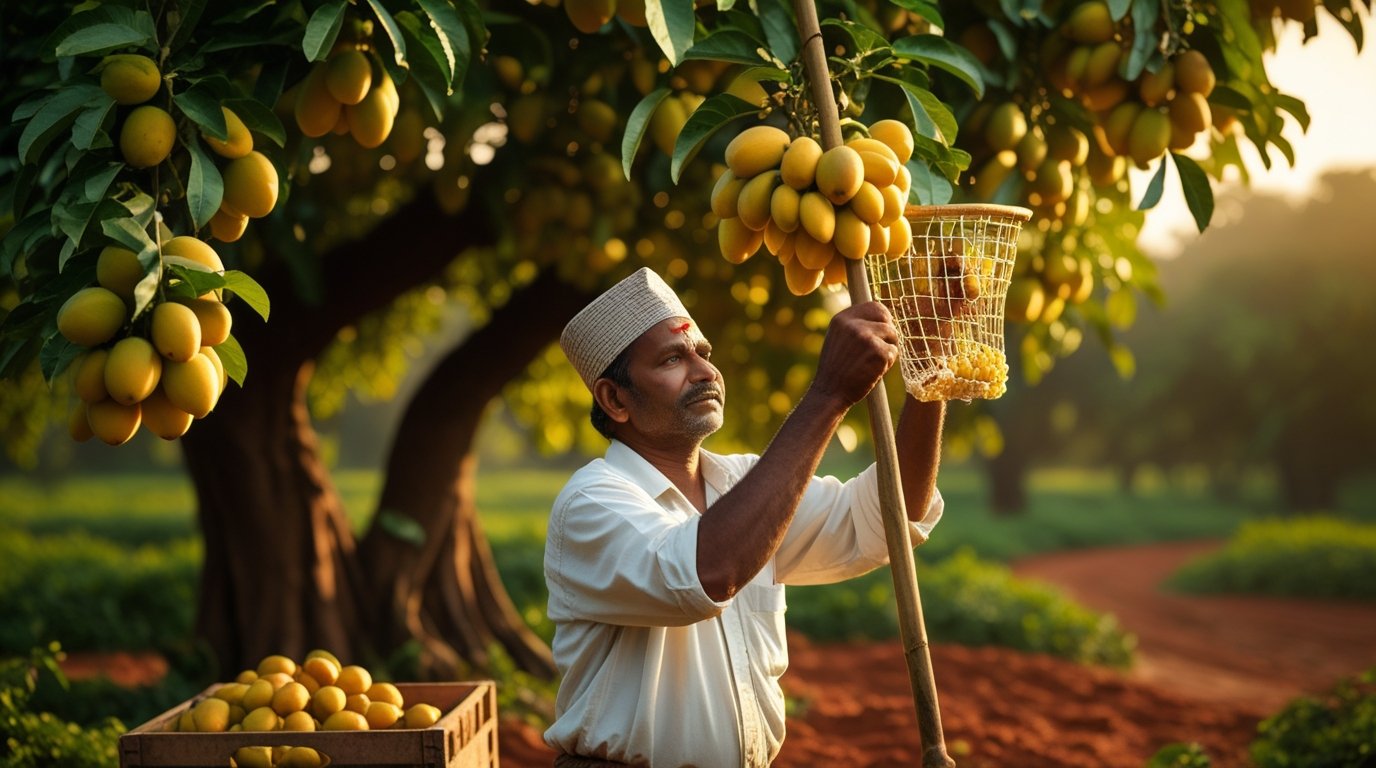
Harvesting at Kokan Samrat is done entirely by hand using the traditional Konkan shikari pole — a long bamboo rod fitted with a small net basket and a curved blade at the tip. Darshan climbs into the lower canopy while a second worker stands below. Each mango is cut from the tree with 10 to 15 centimetres of stem still attached — never pulled, never twisted, never dropped. The stem seal prevents sap from burning the skin, which would cause black marks and accelerated spoilage that no amount of careful handling can reverse.
The net basket catches each fruit as it is cut, lowering it gently to the worker below, who places it — not drops it — into a lined crate. The rhythm of this process is slow and deliberate. Darshan harvesting carefully can manage between 300 and 400 mangoes in a single morning. Speed is not the priority. Every fruit that arrives at the grading table without a bruise or a sap burn is a fruit that can be sold at full value — and Darshan knows the difference between each one.
9:00 AM — Grading, Sorting, and the Moment of Decision
By mid-morning, the day’s harvest is on the grading table. This is one of the most skilled and consequential parts of Darshan’s day — because the decisions made here determine what the customer receives. Every mango is handled individually, examined for size, shape, skin condition, and the development stage of its ripeness. Fruits showing any sap burn, pressure bruising, or pest damage are removed from the premium batch and redirected to processing. Fruits that are uniform in size, clean-skinned, and at precisely the right ripeness stage for the delivery destination are sorted and set aside for packaging.
This grading process is where Darshan’s knowledge of individual trees becomes commercially valuable. He knows which trees in the orchard run slightly larger, which ripen a week ahead of the others, which are prone to spongy tissue in a warm season — and he grades their fruit accordingly, calibrating the final pack for the distance each batch will travel before it is opened.
11:00 AM — Orchard Maintenance: The Work That Never Stops
The harvest takes the morning. The orchard takes the rest of the day. During the fruit development season — from February through May — Darshan’s afternoon is structured around the specific needs of trees still carrying developing fruit. Irrigation scheduling is monitored closely: too much water during the final weeks before harvest dilutes the Alphonso’s sugars and produces watery, less aromatic fruit. Too little causes fruit to drop prematurely. Darshan manages this balance between the tree’s needs and the fruit’s chemistry in real time, drawing on years of watching the same trees respond to the same seasonal shifts.
Pest monitoring is a constant, unglamorous necessity. The mango fruit fly — Bactrocera dorsalis — is Darshan’s most persistent enemy during the ripening phase, and pheromone traps placed throughout the orchard are checked and baited every single afternoon. Fallen fruit is collected and removed from the orchard floor daily — because rotting fruit on the ground breeds the next generation of pests faster than any other single factor.
2:00 PM — Packaging and Dispatch
In the heat of the afternoon, the day’s graded mangoes are packed. Darshan oversees every box — each fruit individually wrapped in a foam net sleeve, nested in a compartmentalized tray, and placed in ventilated five-ply corrugated boxes that have been prepared and labeled since the morning. At Kokan Samrat, boxes are packed to the courier’s daily pickup schedule — ensuring that no packed box sits waiting beyond its optimal dispatch window. Every hour between packing and pickup is an hour of unnecessary heat exposure, and Darshan tracks each one.
4:00 PM — Evening Walk and the Long View
As the afternoon heat begins to ease, Darshan takes his evening walk through the orchard — not for harvest, not for maintenance, but for observation. He is watching how the canopy is developing, estimating how many days remain before the next block of trees reaches harvest readiness, noting where the flowering was uneven this season and marking those trees for post-harvest pruning attention.
This is the part of Darshan’s day that no customer sees and no delivery box can communicate — the long, patient relationship between a farmer and his land that accumulates over decades into the kind of knowledge that makes Kokan Samrat mangoes what they are. The orchard is not a factory. It is a living system, and Darshan is not a laborer following a protocol. He is a custodian of something rare — a specific combination of soil, climate, genetics, and craft that produces one of the most extraordinary fruits on earth.
The mango in your hand did not begin with an online order. It began with Darshan walking his orchard before the sun came up, reading his trees the way a doctor reads a patient — with years of attention, genuine care, and the quiet confidence of someone who knows exactly what he is doing.