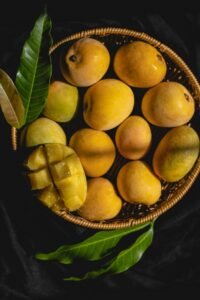
India grows approximately 1,500 named mango varieties — and the country eats perhaps fifteen of them with any regularity. The Alphonso, the Kesar, the Dasheri, the Langra, the Banganapalli: these five names account for the overwhelming majority of what appears in markets, online stores, and fruit bowls across the country each season. The rest — the other 1,485 varieties that carry extraordinary flavors, improbable names, and histories that stretch back centuries — exist in isolated orchards, in the memory of elderly farmers, and in the increasingly endangered agricultural biodiversity of a country that is steadily trading its culinary heritage for commercial convenience.
This article is about the varieties that deserve your attention before the window to try them closes permanently — the unusual, the rare, the misunderstood, and the genuinely extraordinary mangoes that India produces but most Indians have never tasted.
Imam Pasand: The King’s Mango
The Imam Pasand is known in Andhra Pradesh, Telangana, and Tamil Nadu by a name that translates directly as “favoured by the Imam” — a reference to its alleged status as the preferred mango of the region’s historical rulers and religious elite. It is not difficult to understand why royalty claimed it: the Imam Pasand is one of the largest mangoes grown in India, with individual fruits routinely reaching 600 to 800 grams, and its flesh is extraordinarily soft — so much so that the skin is edible, requiring none of the peeling and cutting that most varieties demand.
The flavor profile is uniquely sweet and mild — almost honeyed without the aromatic intensity of an Alphonso, cleaner and less assertive but deeply, purely sweet in a way that makes most other varieties seem busy by comparison. The Imam Pasand is available only in May and June, is notoriously difficult to transport due to its soft skin, and is found primarily in Andhra Pradesh’s specialist orchards. If you can find it, buy more than you think you need.
Noor Jahan: The Giant with a Quiet Voice
Named for the famous Mughal empress, the Noor Jahan is the largest naturally occurring mango variety in India — single fruits regularly weigh over one kilogram, with exceptional specimens reaching two. It is grown almost exclusively in the Alirajpur district of Madhya Pradesh, where a handful of families maintain the trees that have produced this variety for generations.
What makes the Noor Jahan paradoxical is that its extraordinary size is not accompanied by the intensity one might expect from such a prominent fruit. Its pale cream flesh is delicate, mild, fiberless, and subtly sweet — a flavor that rewards patience rather than demanding attention. It is a mango for people who find the Alphonso’s assertive fragrance and acidity too much — a quieter, more contemplative fruit whose extraordinary physical scale is its most immediate characteristic and whose flavor reveals itself slowly. Only a few hundred trees are in production, making it among the rarest commercial mangoes in India.
Gulapkhas: The Rose-Scented Mango of Bihar
The name Gulapkhas translates as “rose-scented” — and for once, a mango’s name is entirely accurate. This Bihar variety produces a medium-sized fruit with deep orange flesh and a floral aroma that is genuinely distinct from every other mango variety’s fragrance profile: where the Alphonso smells of honey and tropical flowers, the Gulapkhas smells specifically of roses, a quality that is disorienting and extraordinary in equal measure the first time you encounter it.
The Gulapkhas is considered among the rarest commercially available mangoes in India — a disappearing variety whose production is limited to a small number of Bihar orchards, available for a window of no more than three to four weeks in late May and early June. Its unusual fragrance makes it difficult to pair with other flavors and therefore challenging to use in recipes, which partly explains its limited commercial appeal. But as a fresh eating mango, it is unlike anything else India produces — a fruit that smells like a garden and tastes like concentrated tropical sweetness.
Kalapadi: The Black Mango of Kerala
The Kalapadi is possibly the most visually striking mango in India — a Kerala variety whose skin turns almost black when fully ripe, creating a visual that looks more like a decorative ornament than an edible fruit. Cut it open and the interior contradicts the exterior entirely: bright, vivid orange flesh with a clean, balanced sweetness-acidity profile and a notably juicy, almost liquid pulp that is exceptional in drinks, sorbets, and raw preparations.
The Kalapadi is classified as nearly extinct in commercial cultivation — its dark skin makes it visually unappealing to consumers trained by decades of golden-yellow mango marketing, and its delicate nature makes long-distance transport nearly impossible. It survives in isolated Kerala orchards and in the collections of agricultural biodiversity conservationists. If you are in Kerala between May and June and encounter one, the correct response is to buy everything available and eat it immediately.
Dudhia Baghalpuri: The Mango That Looks Like Porcelain
Grown primarily in Bihar’s Bhagalpur district, the Dudhia Baghalpuri is the only mango variety in India with a naturally white skin — a porcelain-pale exterior that is so visually anomalous among the golden-yellow norms of the mango world that first-time buyers consistently mistake it for an unripe fruit.
The inside contradicts the outside completely: vibrant orange flesh with a distinctive aroma that experienced tasters describe as resembling freshly cut rice — earthy, slightly starchy, and warm in a way that no other mango’s fragrance quite replicates. The Dudhia Baghalpuri is not for everyone — its flavor profile is more complex and less immediately accessible than the Alphonso’s crowd-pleasing fragrance — but for the eater who wants something genuinely different from the familiar script of Indian mango flavors, it is a revelation.
Rumani: The Custard Mango of Karnataka
The Rumani — also spelled Rumana — is a heritage Karnataka variety with an elongated, curved shape and a flesh consistency that has been compared repeatedly and accurately to thick custard. Its flavor is complex in a different way from the Alphonso: rather than the honey-floral aromatic signature of Konkan mangoes, the Rumani delivers a rich, almost vanilla-like sweetness with subtle spiced undertones — cardamom is the flavour note most tasters identify, though the variety contains no cardamom and produces this character entirely through its own biochemistry.
The Rumani is classified as a rare heritage variety within Karnataka, largely displaced in commercial orchards by higher-yielding modern cultivars. It remains available through specialist Karnataka growers and a small number of heritage orchard conservation projects, typically in May and early June.
Batasha: The Sugar Candy Mango of Bengal
The Batasha’s name is borrowed from the small sugar confections — batasha — that are offered at Bengali religious ceremonies, and the comparison is apt: this West Bengal variety is exceptionally sweet, with a thin skin, succulent pulp, and a sugar concentration that surpasses virtually all other Indian varieties by measured Brix level.
Its rarity is a direct consequence of its most appealing quality: the Batasha is too delicate to transport commercially. The thin skin that makes it melt on the tongue makes it bruise in transit within hours of harvest — which means it is available only within a short distance of the orchards that produce it in isolated rural Bengal. It is, in every practical sense, a local secret that geography has preserved from commodification — and if you find yourself in rural West Bengal between April and June, this is the variety to seek above all others.
The Quiet Emergency
Behind every variety in this list is an agricultural conservation crisis that unfolds silently between mango seasons. India’s extraordinary mango biodiversity — the 1,500 varieties that represent thousands of years of cultivation, selection, and regional adaptation — is contracting. Varieties that cannot be transported, that do not meet the cosmetic standards of urban retail, that peak in brief windows incompatible with supply chain logistics, are disappearing from active cultivation with each passing decade.
The unusual mango varieties in this article are not simply interesting eating experiences. They are living connections to India’s agricultural history — each one a genetic record of the specific soil, climate, and human knowledge that produced it. Eating them, buying them when you can find them, and supporting the farmers who still grow them is the most direct contribution any individual consumer can make to keeping them alive.
Start this season. Try one variety you have never heard of. The window is always shorter than you think.