History’s most consequential encounters are rarely the ones we plan. When the British East India Company first established its commercial foothold on the Indian subcontinent in the early 17th century, it came seeking pepper, textiles, indigo, and saltpeter — the commodities that powered European commerce and military ambition. It did not come looking for a mango. Yet by the time British colonial rule was fully consolidated across India in the 19th century, the Alphonso mango of the Konkan coast had worked its way so thoroughly into the British imperial imagination — into the journals of colonial officers, the correspondence of governors, the menus of Government House dinners, and the commercial records of port trade — that the story of the British and the Alphonso had become one of the most revealing subplots of the entire colonial encounter. This is that story.
The East India Company’s India: A World Already Saturated with Mango
When the East India Company’s first permanent trading post was established at Surat in 1612, the mango was not a discovery for the Company’s traders — it was an immediate, overwhelming sensory reality. The Indian subcontinent had been cultivating mangoes for over 4,000 years by the time British merchants first tasted them on Gujarati soil. Buddhist monks had carried the fruit to Southeast Asia in the 4th century BCE. Mughal emperors had planted orchards of one hundred thousand mango trees at Lakhibagh, where Portuguese Jesuit priests — already in India decades before the East India Company — had trained Akbar’s royal horticulturists in the art of grafting.
The mango, in other words, had already been the subject of centuries of cultivation, poetry, religious symbolism, diplomatic exchange, and royal passion before a single British officer first bit into one. What the East India Company brought to the mango encounter was not discovery in the conventional sense — it was the systematic capacity to document, commodify, and eventually export what it found. And in the Alphonso of the Konkan coast, it found something worthy of all three.
James Forbes and the Birth of the British Mango Imagination
The most vivid and historically significant British encounter with Indian mangoes in the East India Company era belongs to James Forbes — a Scottish youth who arrived in India in 1765 as a Company Writer and spent the next seventeen years sketching, painting, and documenting every remarkable natural phenomenon he encountered.
Forbes’ engagement with the mango was not casual. He became genuinely fascinated by the fruit — its varieties, its cultivation, its cultural significance, and its flavor — and documented it with the same methodical attention he gave to the temples, plants, and people that filled his celebrated Oriental Memoirs. His observations about mango cultivation along the Konkan coast and the Western Ghats were among the first systematic British records of the Alphonso variety’s growing environment and character — and they reflect an encounter between a colonial administrator’s analytical mind and a fruit of extraordinary complexity that he clearly found as challenging to describe as it was irresistible to consume.
Forbes’ encounter with the mango echoed, as he himself noted, those of the great earlier visitors to India — from the Buddhist pilgrims Fa-Hien and Hiuen Tsang, who had immediately recognized the mango’s centrality to Indian spiritual life, to the Mughal Emperor Babur, who found Indian mangoes one of the few genuine consolations of a land he otherwise described with famously unflattering adjectives. In placing himself in this lineage of mango-captivated visitors to India, Forbes was acknowledging something that the East India Company as an institution would take longer to formalize: that India’s greatest fruit was a subject worthy of serious attention.
Devgad as a Refuelling Station: How British Ships Encountered the Alphonso
One of the most intriguing theories about the British East India Company’s specific encounter with the Ratnagiri Alphonso comes not from official company records but from oral history preserved by the mango-farming communities of Devgad — one of the GI-certified Alphonso-growing districts of the Konkan.
According to accounts preserved within the Devgad Taluka Mango Growers’ Co-operative Society, Devgad served as a refuelling and provisioning station for English vessels in the 1850s. British ships making the coastal run between Bombay and Goa — and sometimes on longer hauls between Britain and the subcontinent — stopped at Devgad’s natural harbor, and the sailors and officers who went ashore began taking a liking to the extraordinary mangoes growing in the coastal orchards surrounding the port.
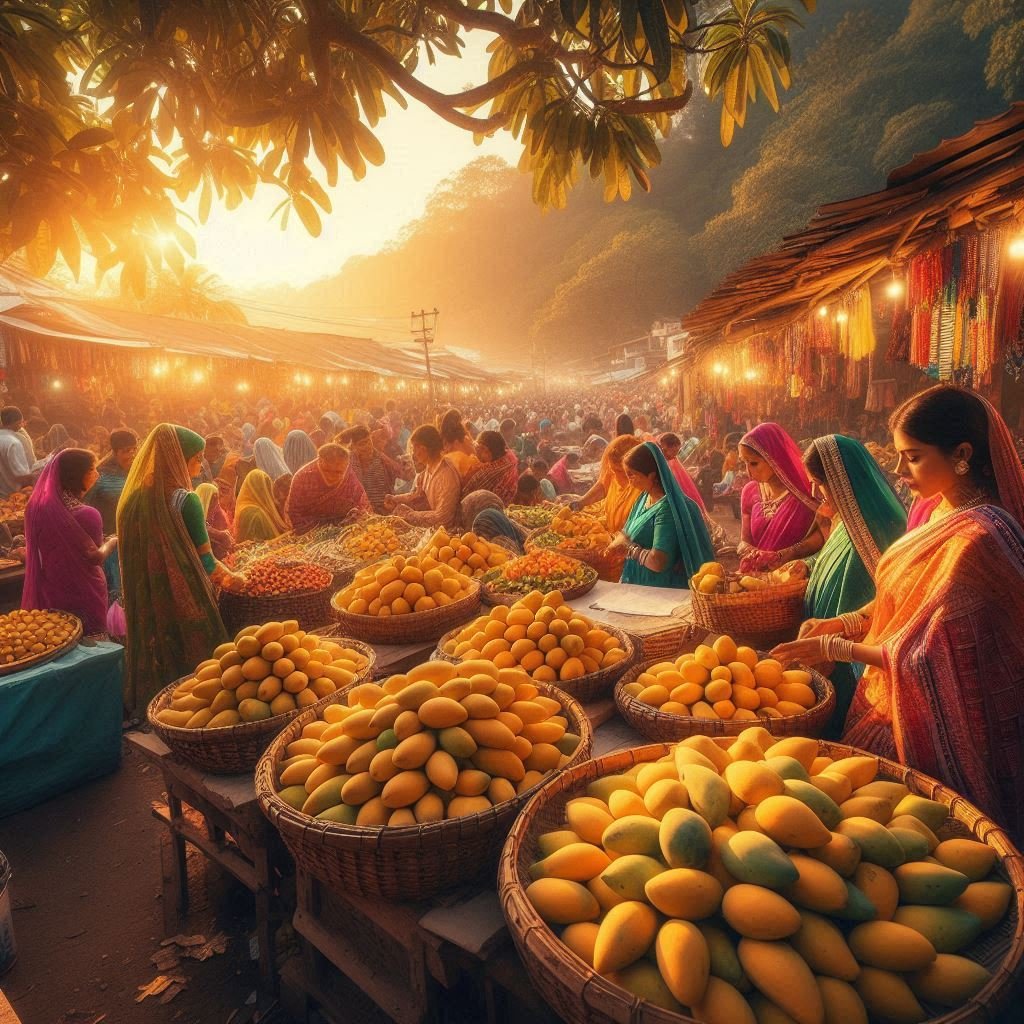
This account positions the Alphonso’s British discovery not as a deliberate horticultural expedition but as a serendipitous harbor encounter — the Company’s men stopping for water and provisions, and finding themselves confronted with a fruit so unlike anything they had encountered in the established ports of Bombay or Calcutta that word began to spread through the Company’s maritime and administrative networks. A few generations later, the families who had first connected Devgad’s mangoes to Bombay’s markets had established ferry services specifically to carry the Alphonso to Crawford Market — the grand Victorian marketplace that became the primary distribution point for premium Alphonso mangoes in colonial-era Bombay.
The Queen’s Mangoes: The 1838 Moment That Changed Everything
The most dramatic and consequential moment in the entire British encounter with the Alphonso mango is documented in a date that mango historians cite with almost ceremonial reverence: May 18, 1838.
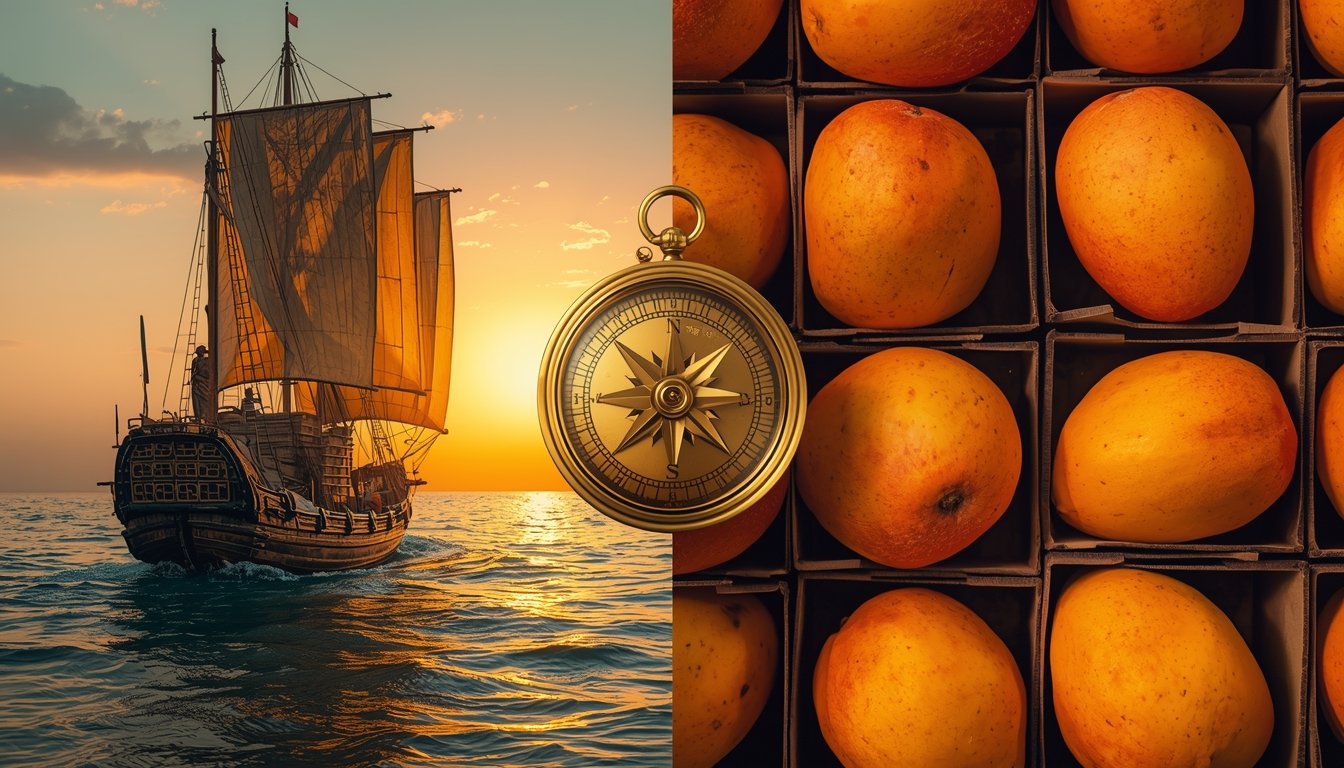
On that date, the first case of Alphonso mangoes left Bombay harbor bound for England — a shipment of Konkan’s finest fruit destined, according to historical accounts, for Queen Victoria herself. The account holds that an Indian advisor to the Queen had communicated the extraordinary qualities of the Alphonso mango to her court, and that the resulting curiosity prompted a formal shipment — packed in specially designed crates with natural insulating material to survive the weeks-long sea voyage around the Cape of Good Hope. The Queen, according to these accounts, was sufficiently impressed by what she tasted that the Alphonso’s reputation at the highest levels of British imperial society was permanently established.
Whether the Queen’s enjoyment is precisely as documented or has been enhanced in the retelling, the underlying historical fact is verifiable and significant: by 1838, the Alphonso mango of the Konkan had established sufficient reputation within British India’s networks to warrant an organized shipment to England — a logistical and commercial effort that required both the fruit’s extraordinary quality and an established demand channel to justify the expense. The 1838 shipment was not an experiment. It was the confirmation of a reputation already well established.
The Gazetteers: How the East India Company Institutionalized the Alphonso
Beyond individual encounters and royal shipments, the East India Company’s — and later the British Raj’s — most lasting contribution to the Alphonso’s documented history was the systematic institutional recording of its commercial significance in the Maharashtra District Gazetteers.
These meticulous administrative records — compiled by British district officers with the same thoroughness they applied to population censuses, revenue assessments, and criminal statistics — documented mangoes as a primary export commodity from Ratnagiri district ports, listed specific varieties including the Alphonso by name, recorded shipping volumes and destinations, and provided agronomic observations about cultivation practices across the Konkan.
The Gazetteer entries for Vijaydurg, Rajapur, Malvan, and Ratnagiri town’s own port all list mangoes among chief exports — with Bombay as the primary destination, and the route being the established coastal steamer and dhow network that the Company’s maritime infrastructure had helped organize and regularize. By institutionalizing the mango trade in official administrative records, the British created a documentation trail that simultaneously preserved the historical record of the Alphonso’s commercial development and legitimized it as a formal industry deserving of administrative attention and infrastructure support.
The Botanical Gardens Connection: Science in the Service of Fruit
The East India Company’s engagement with the Alphonso was not confined to commerce and consumption — it extended into botanical science. The Royal Botanic Garden at Calcutta — established by the Company in 1787 — became one of the most important centers for the systematic study of Indian plant life, including mango varieties.
Company botanists documented, classified, and analyzed mango varieties from across India’s regions — creating scientific records that complemented the commercial records of the Gazetteers and contributed to the global dissemination of knowledge about the Alphonso’s unique characteristics. This botanical documentation work laid the scientific foundation for the variety’s eventual GI certification — establishing, through written record, the principle that the Alphonso’s quality was inseparable from its specific geographic and ecological origin.
The Company’s botanical institutions also played a role in the global movement of mango varieties. Mango cultivars arrived in Florida in the 1830s and California in the 1880s — and the maritime networks of the British Empire were the primary channel through which these varieties traveled. The same institutional infrastructure that documented the Alphonso in Konkan’s Gazetteers was simultaneously spreading mango cultivation to the Caribbean, Florida, and East Africa — making the East India Company’s botanical legacy one of the most geographically far-reaching in the history of tropical fruit cultivation.
The Colonial Legacy and Its Complicated Inheritance
The East India Company’s encounter with the Alphonso mango is, like all colonial encounters, a story of both appropriation and preservation. The Company took from India what it found valuable — documenting it, shipping it, and institutionalizing it within frameworks of imperial commerce that served British interests first. At the same time, it created records, established trade infrastructure, and generated documented demand that contributed to the Alphonso’s commercial survival and global recognition.
The GI tag that the Alphonso Mango received from the Indian government in 2018 — formally protecting the variety’s geographic origin across five Konkan districts — is, in a very real sense, the culmination of a recognition process that began in East India Company Gazetteer entries written two centuries earlier. The British documented what they found extraordinary. India eventually learned to protect it.
The Alphonso did not need the British to become magnificent — it achieved that through the work of Portuguese grafters, Konkan farmers, Peshwa patrons, and the remarkable laterite soil of Ratnagiri’s hillsides. But the Company’s encounter with this fruit helped make it legible to the world — gave it a documented commercial history, a reputation beyond the subcontinent, and a paper trail that ultimately served the cause of its protection. In this, the British discovery of the Alphonso mango is a story with a surprisingly satisfying ending.