There is a moment every mango lover knows well — standing at a market stall, surrounded by dozens of mangoes, completely uncertain which one deserves to come home. Some look beautiful but taste flat. Others feel right but smell like nothing. And occasionally, you bite into one that is pure magic — fragrant, sweet, silky, and absolutely perfect. That difference between a disappointing mango and a transcendent one rarely comes down to luck. It comes down to knowledge. The experts at Kokan Samrat have spent generations learning exactly what separates a truly exceptional Alphonso mango from an ordinary one — and this guide shares everything they know.
Why Choosing the Right Mango Matters More Than You Think
Most consumers accept whatever mango reaches them without question. But the journey from orchard to table involves dozens of decisions — harvest timing, storage conditions, transport handling, ripening methods — each of which profoundly affects the final eating experience and nutritional value of the fruit.
A mango harvested prematurely and artificially ripened with calcium carbide may look identical to a naturally tree-matured Alphonso — but bite into both and the difference is immediate. One is flat, fibrous, and faintly chemical. The other is aromatic, melt-in-the-mouth, and alive with flavour complexity that only full natural development produces. Knowing how to identify the genuinely superior fruit protects your money, your health, and your mango experience every single time.
The Four Senses of Mango Selection
1. Smell — Your Most Reliable Guide
If there is one single piece of advice the Kokan Samrat team offers above all others, it is this — always smell the mango before you buy it. A naturally ripened Alphonso mango announces itself through fragrance before you even touch it. The aroma should be rich, floral, and intensely tropical — emanating from the stem end of the fruit where concentration is highest.
A mango with little to no smell is either underripe, artificially ripened, or past its prime. A chemical or fermented odour indicates mishandling or over-ripeness. The fragrance of a genuine Alphonso — often described as saffron-kissed and honeyed — is unmistakable once you’ve experienced it. Let your nose lead every mango purchase.
2. Touch — Firmness With a Promise
Gently press the mango with your fingertips — never squeeze hard, which damages the fruit and disrespects the farmer’s work. A ripe mango should yield slightly under gentle pressure, similar to a ripe avocado. It should feel full and heavy for its size, indicating dense, well-developed pulp rather than a hollow or shrunken interior.
Avoid mangoes that are rock hard — they are underripe and will not develop full flavour even after home ripening. Equally avoid those that feel mushy or collapse under the lightest touch — they are overripe, likely fermenting internally, and will disappoint on the plate.
3. Appearance — Read the Skin, Not Just the Colour
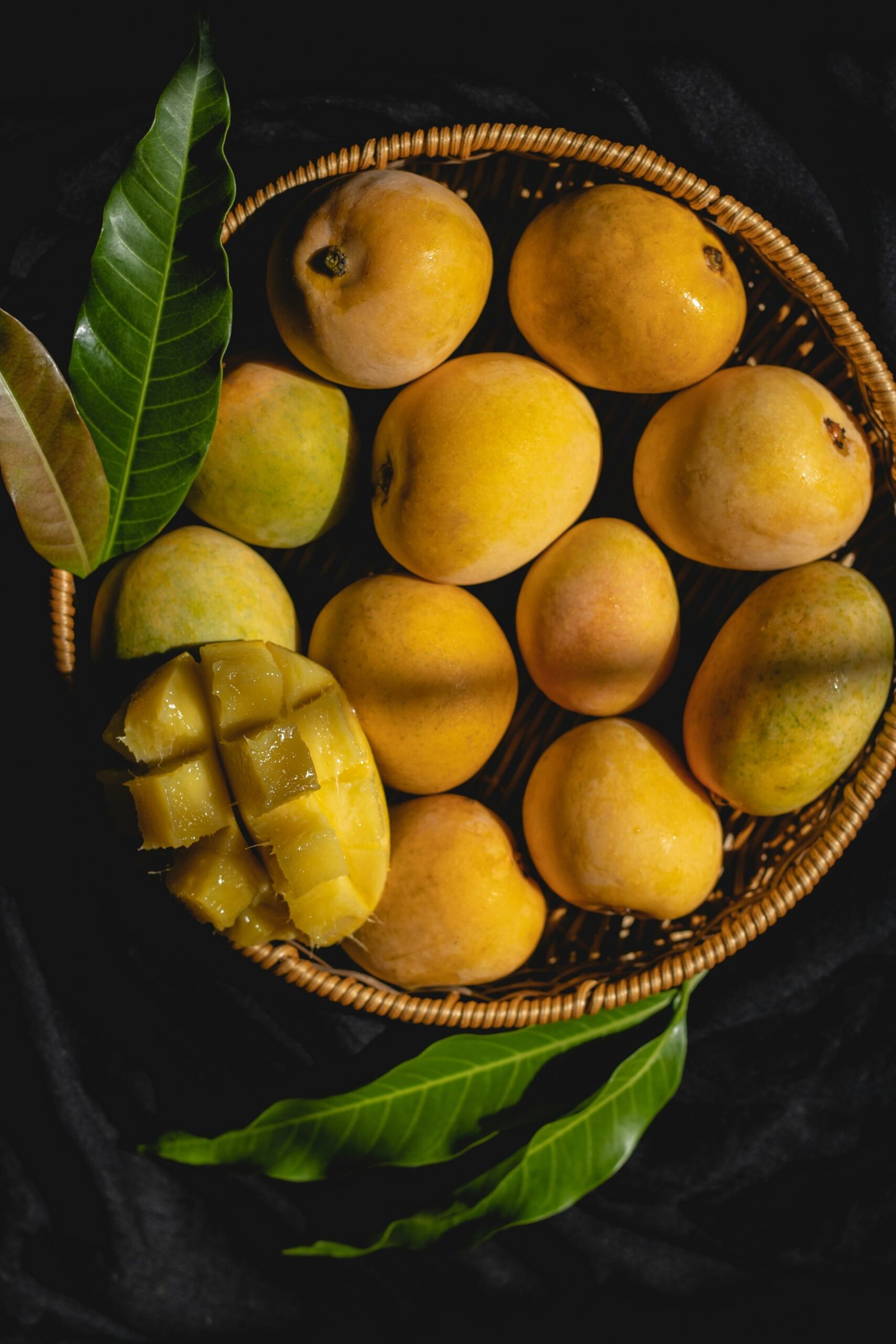
The golden myth of mango selection is that colour equals ripeness. It doesn’t — not reliably. Alphonso mangoes ripen to a saffron-yellow with occasional green patches, but skin colour varies by variety, growing region, and season. A slightly green Alphonso can be perfectly ripe, while a brilliantly yellow mango may have been chemically treated.
What the skin does reliably communicate is condition. Look for:
- Smooth, taut skin without wrinkles — wrinkling indicates moisture loss and declining freshness
- No dark soft patches or bruising — these signal impact damage or disease
- A naturally waxy sheen — the fruit’s own protective coating, which diminishes after washing or rough handling
- A plump, well-filled shape — an Alphonso should feel generous and rounded, not flat or pinched
4. Weight — Density Is Everything
Pick up the mango and assess its weight relative to its size. A high-quality Alphonso should feel surprisingly heavy — dense with pulp and juice rather than light and airy. Low weight often indicates underdeveloped fruit, excessive fibre, or dehydration from improper storage. The heaviest mango in a group of similar-sized fruit is almost always the finest one.
Identifying Artificially Ripened Mangoes
One of the most important skills a mango consumer can develop is recognising fruit ripened through calcium carbide — a chemical agent that triggers premature yellowing without allowing the natural biochemical ripening process to complete.
Warning signs of artificially ripened mangoes include:
- Uniform, unnaturally bright yellow skin with no variation or natural patches
- No fragrance or a faint chemical smell near the stem end
- Hard or uneven flesh — yellow on the outside but green, starchy, or fibrous inside
- No sweetness depth — flat, one-dimensional flavour without the floral complexity of naturally ripened fruit
- Skin that peels unevenly or appears slightly chalky in texture
Naturally ripened Alphonso mangoes from trusted sources like Kokan Samrat ripen unevenly and organically — showing colour variation, emanating genuine fragrance, and delivering flesh that is uniformly golden, smooth, and extraordinarily flavourful throughout.
Storing Your Mango After Purchase
Choosing a great mango is only half the journey — storing it correctly preserves the quality you’ve carefully selected.
- Unripe mangoes should be stored at room temperature away from direct sunlight, ideally wrapped loosely in newspaper to encourage even ripening
- Ripe mangoes should be refrigerated and consumed within 2–3 days for peak flavour and nutritional value
- Never refrigerate unripe mangoes — cold temperatures halt the ripening process and cause irreversible texture damage
- Allow refrigerated mangoes to rest at room temperature for 20–30 minutes before eating — cold dulls the aromatic compounds that make Alphonso so extraordinary
The Kokan Samrat Standard: Quality You Can Trust
For consumers who want to eliminate the guesswork entirely, sourcing mangoes directly from verified, farm-certified origins is the most reliable path to consistent excellence. Every Alphonso mango from Kokan Samrat’s Ratnagiri orchards is harvested at natural physiological maturity — never forced, never chemically accelerated, never compromised. Each fruit is hand-selected, carefully graded, and packed with the same attention to quality that the Kokan Samrat name has represented for generations.
When you buy from Kokan Samrat, you’re not just buying a mango. You’re buying the certainty of knowing exactly where it came from, how it was grown, and that every sensory promise — the fragrance, the colour, the weight, the taste — has been earned honestly by the fruit and the farmer both.
Choose with knowledge. Eat with confidence. And never settle for anything less than the perfect mango.