Every summer, millions of Indian consumers buy mangoes believing they are getting the real thing — and a significant proportion of them are not. The mango they bring home looks ripe, smells vaguely sweet, and has the right color. But something is off. The flavor is flat. There is no fragrance. The pulp is dry in places and watery in others. The fruit is soft by the second day and beginning to ferment by the third. What they have purchased is not a naturally ripened mango — it is one that was harvested raw, exposed to calcium carbide or acetylene gas in a closed chamber, and forced through the external appearance of ripeness without the internal biochemistry that makes a naturally ripened mango what it is.
This is not a minor food quality issue. Calcium carbide — still widely used by traders despite being explicitly banned by FSSAI under the Prevention of Food Adulteration Act — releases acetylene gas that contains harmful traces of arsenic and phosphorus. Regular consumption of carbide-ripened fruit has been linked to dizziness, nausea, vomiting, skin irritation, respiratory problems, neurological disturbance, and in cases of prolonged exposure, more serious long-term health consequences. The ability to tell the difference between a farm-fresh naturally ripened mango and a chemically forced one is not just a matter of taste — it is a matter of health.
The Skin Test: Color Is Never the Full Story
The most visible difference between a naturally ripened and an artificially ripened mango is in the character of its skin color — but you need to know what to look for, because the difference is in the quality of the color, not simply its presence.
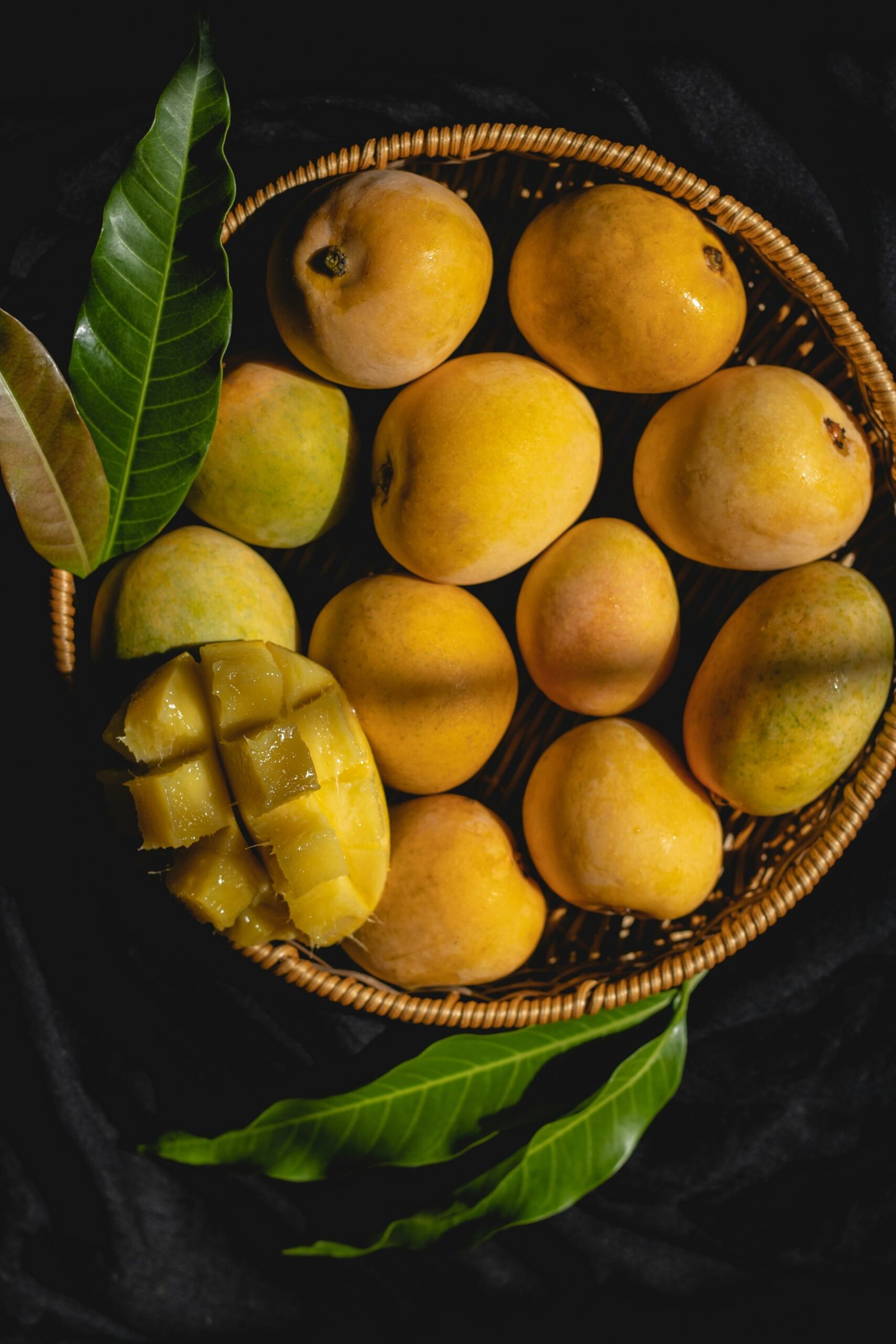
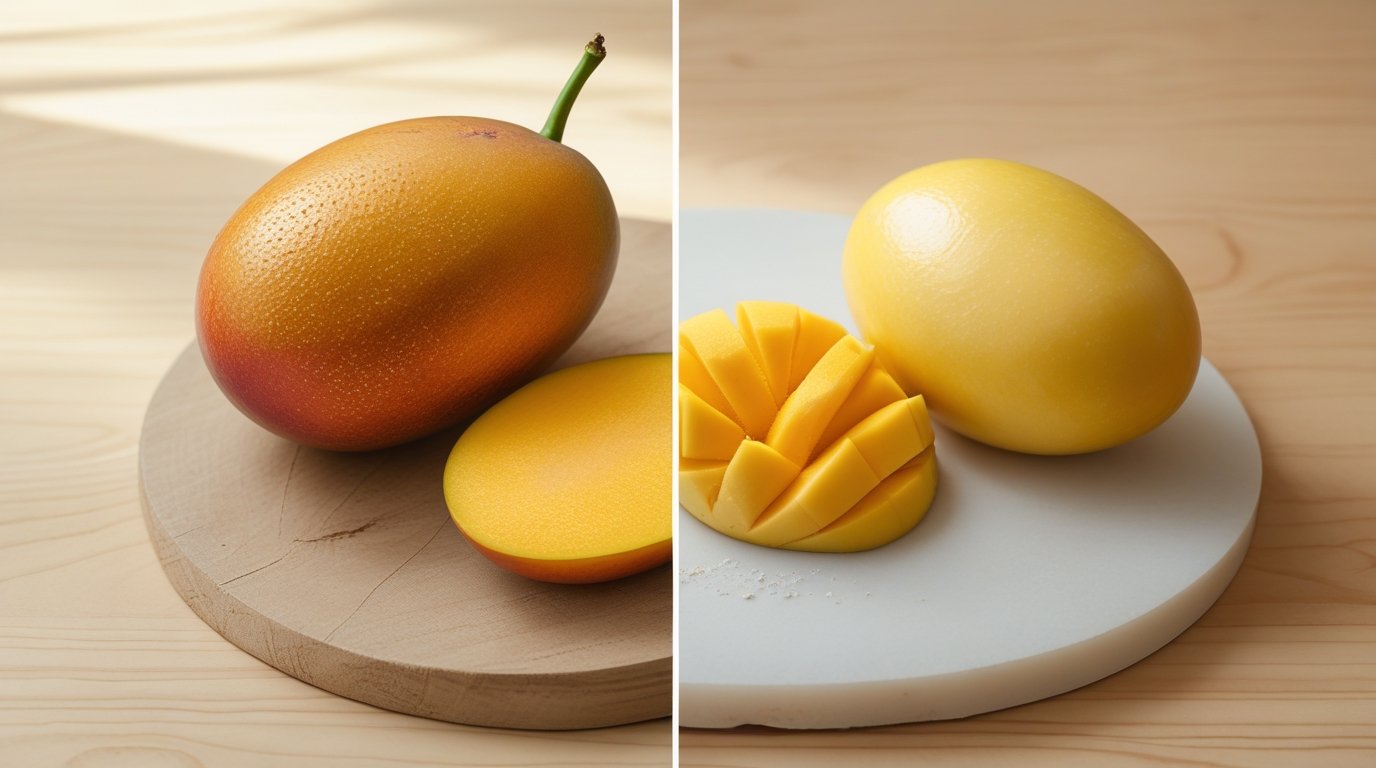
A naturally ripened Alphonso mango develops its golden-yellow color unevenly — a deep amber-gold at the shoulders and lower body, transitioning to a slight greenish tinge near the stem end, sometimes with a faint reddish blush on the sun-exposed side. The color gradation is organic and non-uniform — it reflects how sunlight reached different parts of the fruit as it hung from the tree. A carbide-ripened mango, by contrast, turns a uniform, flat, unnaturally bright yellow or orange across its entire surface — the chemical process forces color change from the outside in, producing a consistency that looks almost plastic-bright under direct light.
Check also for a chalky white or greyish powdery residue on the skin — this is a direct physical deposit of calcium carbide powder that was applied to or around the fruit during forced ripening. A clean, dry, smooth mango skin with natural variation in color is the first sign you are looking at an honest fruit.
The Smell Test: The Most Reliable Single Check
If you remember nothing else from this article, remember this: smell the stem end. For every mango variety, the base of the stem is where the fruit’s natural aromatic compounds are most concentrated and most detectable — even before the mango is cut.
A naturally ripened Alphonso mango produces a powerful, sweet, honeyed floral fragrance near the stem even when still firm-ripe. The aroma is immediate, distinctive, and unmistakably of the fruit itself. A carbide-ripened mango either has no fragrance — because the aromatic terpenoids that create natural mango perfume require the full biological ripening process to synthesize — or it smells faintly chemical, acrid, or dusty near the stem.
Scientific research confirms this difference quantitatively: naturally ripened mangoes score significantly higher on organoleptic aroma evaluation than carbide-ripened mangoes, with aroma scores of 8.62 vs. significantly lower values recorded for calcium carbide-treated fruit. Your nose is a more reliable analytical instrument than most people give it credit for — and in a mango, it is the single most efficient first screening tool available.
The Texture and Press Test
Gently press the mango with your thumb at the widest point of the fruit. A naturally ripened mango that is ready to eat yields evenly — a slight give across the entire surface, consistent from one side to the other, with the flesh returning gently when pressure is released. The ripeness feels like it came from within.
A carbide-ripened mango often yields unevenly — soft in patches near the skin, still firm or slightly pithy deeper within, because the chemical process ripens from the outside inward without allowing the starches and pectin throughout the full depth of the pulp to convert naturally. You may also notice the skin wrinkling, shriveling slightly, or developing small cracks that would not appear on a naturally ripened fruit at the same stage.
Cut It Open: The Pulp Tells the Truth
The most definitive test happens the moment you cut the mango open. A naturally ripened Alphonso has deep, uniformly golden-orange pulp throughout — no white or pale patches near the seed, no fibrous stringy texture near the skin, and a consistent glistening moisture that reflects the fruit’s natural juice content.
A carbide-ripened mango, cut open, often reveals color inconsistency — golden-yellow near the skin but pale or whitish-yellow closer to the seed, reflecting the inward-to-outward ripening gradient that forced ripening produces. The pulp may appear dry or chalky in areas despite being soft, and the flavor — the ultimate test — will be noticeably lacking: flat sweetness with no aromatic depth, occasional bitterness at the finish, and none of the layered complexity that a genuinely ripe Alphonso or Kesar delivers.
Research published in Scientific Reports found that calcium carbide-treated mangoes had vitamin C levels 31 percent lower than naturally ripened mangoes, with significantly reduced citric and malic acid content, lower mineral levels, and measurably lower scores across every organoleptic parameter including taste, aroma, and overall acceptability.
The Shelf Life Test: Nature Takes Longer
A naturally ripened mango at peak condition, kept at room temperature, remains in optimal eating condition for 3 to 5 days after reaching full ripeness. A carbide-ripened mango typically begins to deteriorate and ferment within 2 to 3 days of purchase — because the forced ripening process has not allowed the natural preservation chemistry of the fruit to develop fully.
If the mangoes you bought last week are already going bad — and you bought them at the peak of ripeness — this accelerated spoilage is itself a diagnostic indicator of artificial ripening. Naturally ripened mangoes give you time. Carbide-ripened mangoes do not.
The Water Float Test — With Important Caveats
A widely circulated home test suggests that naturally ripened mangoes sink in water while carbide-ripened ones float. This test has partial scientific basis — naturally ripened mangoes are generally denser due to their fully developed sugar and mineral content — but it is not reliable enough to use as a standalone test, particularly for lighter varieties and smaller fruit. Use it as one additional data point alongside the color, smell, texture, and cut tests rather than as a definitive answer.
Where You Buy Matters More Than Any Test
The most effective protection against carbide-ripened mangoes is not a test — it is a purchasing decision. Farm-direct brands and trusted local producers who harvest their fruit at the correct biological ripeness stage and dispatch same-day have no incentive and no need to use artificial ripening agents. At Kokan Samrat, our Alphonso mangoes are harvested only when the fruit has reached natural ripeness on the tree — packed the same morning and dispatched the same day, arriving at your door in the condition the orchard intended.
No chemical, no shortcut, and no supply chain trick can produce what a tree and a good farmer and Ratnagiri’s unique soil produce naturally. The difference is in the fragrance — and once you have smelled it, you will never mistake the imitation for the real thing again