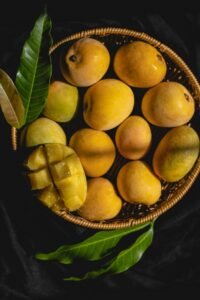
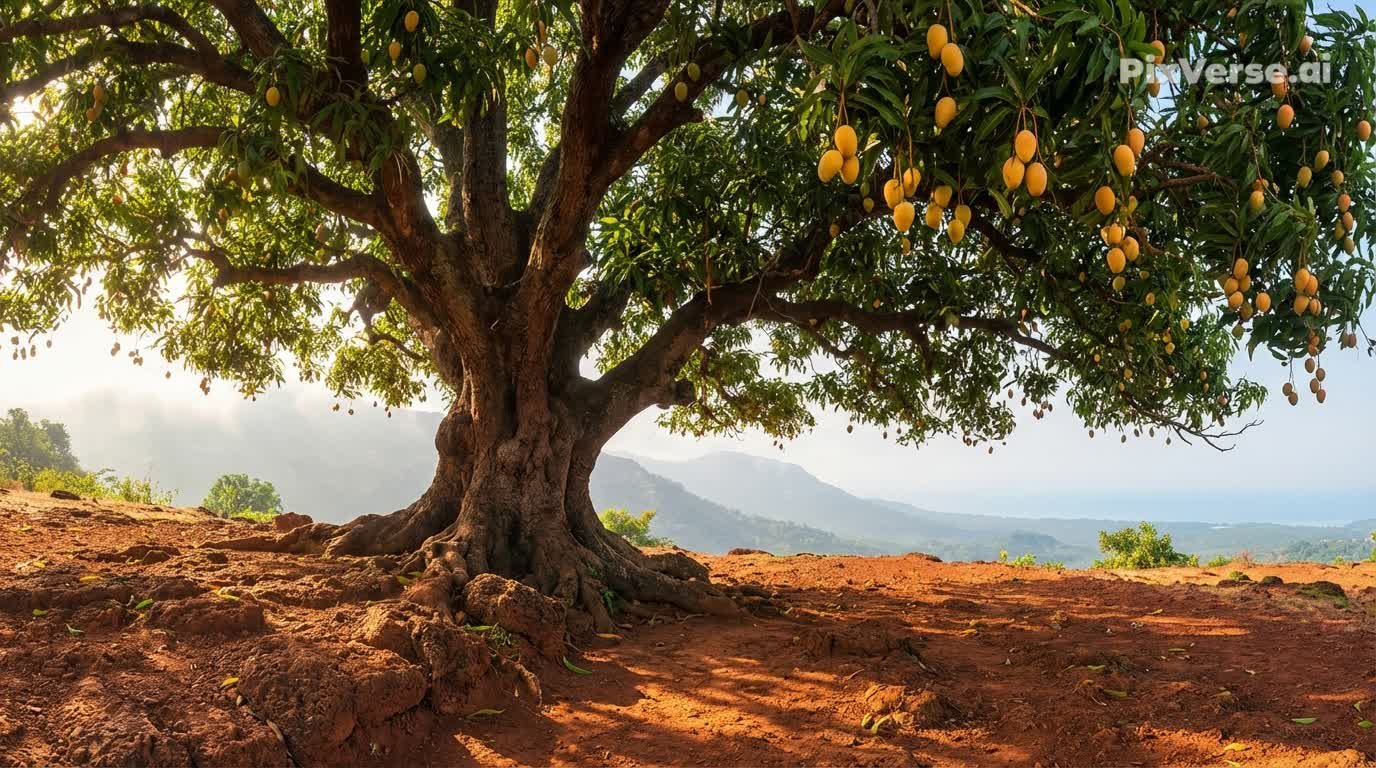
There are mango trees in Konkan that have been bearing fruit since before your great-grandparents were born. Trees that have survived a hundred monsoons, witnessed generations of the same family work their orchards, and still flower every January with the same quiet reliability. A grafted Alphonso mango tree in Ratnagiri can live and productively fruit for well over 100 years — and some ancestral trees in the region are estimated to be nearly two centuries old. This extraordinary longevity is not luck. It is the cumulative result of geography, soil chemistry, climate precision, and generations of thoughtful human care — all working together in a region uniquely designed by nature to keep a mango tree alive and thriving for a very long time.
The Laterite Root Advantage
In most agricultural soils, mango tree roots spread relatively shallow, occupying the upper layers of nutrient-rich, well-watered soil. In Konkan, the growing conditions begin with an apparent paradox — the predominant soil type is laterite, a dense, iron-rich, reddish volcanic rock that is notoriously resistant to root penetration.
The challenge of laterite, counterintuitively, is the source of the Konkan mango tree’s extraordinary durability. Because the laterite layer resists shallow root development, mango trees planted in blasted rock pits are forced to send their roots deep — down through cracks in the laterite, into underlying zeolitized basalt formations rich in calcium and trace minerals. Research from BSKKV Dapoli suggests that these zeolite minerals, present in the basalt beneath the laterite, provide a slow, consistent, long-term supply of nutrition that sustains tree health for decades without degrading. Unlike nutrient-rich alluvial soils that can be rapidly depleted by intensive farming, the mineral supply in Konkan’s geological layers replenishes itself naturally — feeding the tree from below for a century without exhausting itself.
This deep anchoring also makes Konkan mango trees structurally more resilient. A tree rooted 10–15 feet into bedrock is far less vulnerable to windthrow, soil erosion, and flooding than one with a shallow root network — and the Konkan coast receives some of the most intense monsoon rainfall in India. The laterite root system essentially builds the tree to withstand exactly the environment it lives in.
The Monsoon-Dry Cycle: Nature’s Annual Reset
One of the most underappreciated reasons for Konkan mango tree longevity is the region’s perfectly defined seasonal rhythm — an intense monsoon from June through September, followed by a completely dry period from October through May. This binary seasonal cycle functions as an annual physiological reset for the mango tree.
During the monsoon, the tree undergoes vegetative growth — pushing new shoots, building canopy, and recovering from the fruiting season. As the rains end in October, new growth flushes appear, setting the stage for flower initiation. The dry winter months — cool, clear, and rain-free — then provide the precise climatic trigger that mango trees require for prolific flowering. This reliable alternation between wet and dry seasons, year after year, means that Konkan mango trees are never physiologically confused — they always know what season it is and what they are supposed to do.
In regions where this seasonal definition is blurred — where rains arrive late, or unseasonal showers interrupt the dry flowering period — trees experience stress cycles that accumulate over years, weakening their immune systems and shortening their productive lives. Konkan’s historically reliable monsoon pattern has protected its mango trees from this cumulative stress, giving them a consistency of lifecycle that few other regions in India can offer.
Sea Air, Moderate Temperatures, and No Extreme Stress
The Konkan coast’s proximity to the Arabian Sea creates a moderating influence on temperature that directly benefits mango tree longevity. Unlike inland growing regions that experience temperature extremes — scorching summers above 45°C and occasional cold spells — the sea-facing Konkan belt maintains temperatures within the optimal range for mango tree physiology for most of the year.
Mango trees under sustained heat stress or cold stress divert biological energy toward survival mechanisms rather than growth and fruiting. Over decades, this chronic stress accelerates cellular aging and reduces productive lifespan. Konkan’s coastal temperature moderation — where summer peaks rarely exceed 36–38°C and winters stay comfortably above 15°C — means trees spend virtually no biological energy on stress management. That conserved energy compounds over the decades into longevity and consistent productivity.
The constant movement of sea-air across Konkan orchards also reduces the buildup of fungal pathogens and pest populations that thrive in stagnant, humid inland conditions. A well-aerated orchard is a healthier one — and healthier trees simply live longer.
Generational Care: The Human Factor
No account of Konkan mango tree longevity is complete without acknowledging the role of the people who tend these orchards. Traditional Konkan mango farming is a multigenerational commitment — families do not just plant trees for themselves but for their children and grandchildren. This long-term perspective shapes how trees are cared for in ways that have profound implications for longevity.
Pruning in Konkan follows a restrained, tradition-guided approach — removing only dead wood and diseased growth, never aggressive shaping cuts that weaken the tree’s architecture. Fertilization is timed with the seasonal cycle rather than imposed on it. Pest management remains largely organic in older orchards. And crucially, traditional Konkan farmers do not uproot underperforming trees after a poor season — they observe, they diagnose, and they wait, understanding that a mango tree’s productivity is cyclical over long periods rather than linear year to year.
This patience — rooted in the knowledge that a well-tended Konkan mango tree is a 100-year investment — creates a culture of orchard stewardship that actively extends tree life. An ancestral Alphonso orchard in Ratnagiri or Devgad is not just a farm — it is a living archive, tended with the same care that one generation extends to the next.
Why Ancient Trees Produce Better Mangoes
Experienced Konkan farmers and agricultural researchers alike agree on one observation: the oldest trees in an orchard consistently produce the most complex-tasting mangoes. As a mango tree ages and its roots penetrate deeper into Konkan’s mineral-rich geological layers, it accesses an increasingly diverse profile of micronutrients that directly express themselves in the fruit’s flavor, aroma, and texture.
This is the ultimate reward of longevity in a Konkan orchard — not just more fruit, but better fruit. The century-old trees that still flower in ancestral Ratnagiri orchards each spring are not relics of the past. They are the finest mango producers in the world, still doing exactly what they were planted to do, in the only place on earth where the land, the sky, and the sea conspire to keep them alive and extraordinary for generations.